

Julius Goepp, James Geyer, Paul Cox
Enteric diseases causing severe diarrhea threaten survival of children and are a source of considerable morbidity in low- and middle-income countries (LMIC)1. Human Noroviruses (HuNoVs), a group of single-stranded RNA, non-enveloped viruses in the family Caliciviridae, are the predominant viral pathogens associated with acute gastroenteritis in humans2,3. HuNoVs are common etiopathogens in travelers’ diarrhea (TD), affecting children and adults traveling from industrialized nations to LMIC, as well as military and diplomatic personnel stationed in endemic regions4,5. HuNoV is also a common agent of outbreaks in long-term care facilities, contributing to excess morbidity and mortality among older adults6.
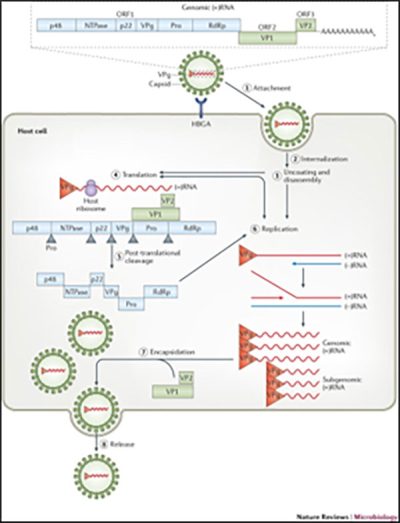
Figure: Life cycle of Human Norovirus, beginning with adhesion of the viral capsid P domain to HBGA moieties on duodenal and jejunal cells7.
Importantly, chronic HuNoV infections can cause gastroenteritis and intestinal barrier dysfunction in both primary and acquired immunodeficiency states, which include patients undergoing immunosuppressive therapies related to hematopoietic stem cell and solid organ transplants, those with human immunodeficiency virus infection, and those with cancer or undergoing cancer treatment8. Although the overall incidence of HuNoV disease in hospital and community settings remains unclear, studies in hematopoietic stem cell transplant recipients suggest an 18% infection rate over one year, and a two-year survey of kidney transplant recipients reported a 17% chronic HuNoV infection rate8-11.
To establish infection, HuNoV must first adhere to mucosal epithelial cells in the duodenum or upper jejunum12,13, as shown in the Figure7. Protruding (P) domains of the viral capsid mediate HuNoV binding to histo-blood group antigens (HBGAs), resulting in cellular invasion and virus replication, and inducing the physical symptoms associated with acute gastroenteritis14,15. Efforts to develop vaccines focus overwhelmingly on preventing or interrupting adhesion of the P-domain to HBGA receptors16. Hence, viral capsid domains have been targets of HuNoV vaccine candidates3. However, diversity among HuNoV variants, including mutations within viral capsid domains, and the emergence of newer genotypes in genogroups I and II (GI and GII, respectively) has complicated vaccine development2,17. Currently, no licensed vaccine against HuNoV is available, though several are in early-stage clinical trials2,17.
Citations
- Luiz WB, Rodrigues JF, Crabb JH, Savarino SJ, Ferreira LC. Maternal vaccination with a fimbrial tip adhesin and passive protection of neonatal mice against lethal human enterotoxigenic Escherichia coli challenge. Infection and immunity. 2015;83(12):4555-4564.
- Hallowell BD, Parashar UD, Hall AJ. Epidemiologic challenges in norovirus vaccine development. Human vaccines & immunotherapeutics. 2019;15(6):1279-1283.
- Netzler NE, Enosi Tuipulotu D, White PA. Norovirus antivirals: Where are we now? Medicinal research reviews. 2019;39(3):860-886.
- Hameed JM, McCaffrey RL, McCoy A, et al. Incidence, Etiology and Risk Factors for Travelers’ Diarrhea during a Hospital Ship-Based Military Humanitarian Mission: Continuing Promise 2011. PloS one. 2016;11(5):e0154830.
- Ashbaugh HR, Early JM, Johnson ME, et al. A Multisite Network Assessment of the Epidemiology and Etiology of Acquired Diarrhea among U.S. Military and Western Travelers (Global Travelers’ Diarrhea Study): A Principal Role of Norovirus among Travelers with Gastrointestinal Illness. Am J Trop Med Hyg. 2020;103(5):1855-1863.
- Cardemil CV, Parashar UD, Hall AJ. Norovirus Infection in Older Adults: Epidemiology, Risk Factors, and Opportunities for Prevention and Control. Infect Dis Clin North Am. 2017;31(4):839-870.
- de Graaf M, van Beek J, Koopmans MPG. Human norovirus transmission and evolution in a changing world. Nature Reviews Microbiology. 2016;14(7):421-433.
- Green KY. Norovirus infection in immunocompromised hosts. Clin Microbiol Infect. 2014;20(8):717-723.
- Bok K, Green KY. Norovirus gastroenteritis in immunocompromised patients. The New England journal of medicine. 2012;367(22):2126-2132.
- Roddie C, Paul JP, Benjamin R, et al. Allogeneic hematopoietic stem cell transplantation and norovirus gastroenteritis: a previously unrecognized cause of morbidity. Clinical infectious diseases : an official publication of the Infectious Diseases Society of America. 2009;49(7):1061-1068.
- Schorn R, Höhne M, Meerbach A, et al. Chronic norovirus infection after kidney transplantation: molecular evidence for immune-driven viral evolution. Clinical infectious diseases : an official publication of the Infectious Diseases Society of America. 2010;51(3):307-314.
- Troeger H, Loddenkemper C, Schneider T, et al. Structural and functional changes of the duodenum in human norovirus infection. Gut. 2009;58(8):1070-1077.
- Costantini V, Morantz EK, Browne H, et al. Human Norovirus Replication in Human Intestinal Enteroids as Model to Evaluate Virus Inactivation. Emerg Infect Dis. 2018;24(8):1453-1464.
- Tan M, Jiang X. Vaccine against norovirus. Human vaccines & immunotherapeutics. 2014;10(6):1449-1456.
- Carmona-Vicente N, Vila-Vicent S, Allen D, et al. Characterization of a Novel Conformational GII.4 Norovirus Epitope: Implications for Norovirus-Host Interactions. J Virol. 2016;90(17):7703-7714.
- Zhu Y, Ma Y, Lu M, et al. Efficient Production of Human Norovirus-Specific IgY in Egg Yolks by Vaccination of Hens with a Recombinant Vesicular Stomatitis Virus Expressing VP1 Protein. Viruses. 2019;11(5).
- Cortes-Penfield NW, Ramani S, Estes MK, Atmar RL. Prospects and Challenges in the Development of a Norovirus Vaccine. Clin Ther. 2017;39(8):1537-1549.